· Essay
Weekly notes Oct 12-16 2026
Taste you can't codify, context you can't buy, and why we should trust the model the least.
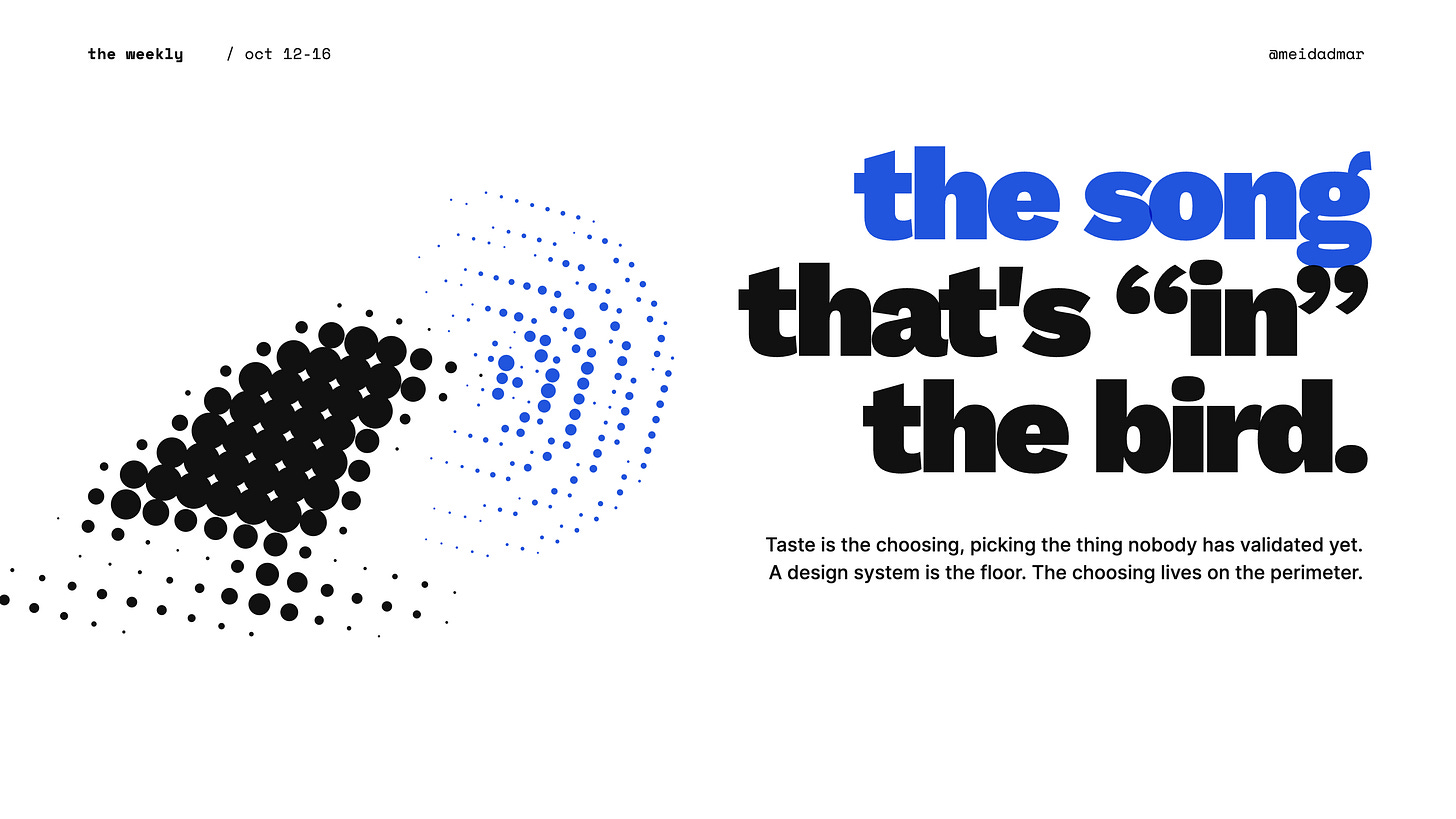
The best response I saw to this week's "what is taste and why is everyone trying to codify it for AI" was one line from @mikeswartz_: "they're trying to cut open the bird to find the song." A thread from @scspeier explains why. My processing:
Taste is relational – to the culture, the moment, the content, the context. A witty output from thoughtfully weighed inputs.
The machines can weigh endless inputs and do it for almost free, yet they still drift to a flat middle.
Taste is the choosing, picking the thing nobody has validated yet. Because it means something to a human and their lived experience.
What makes taste special is the unexpectedness of it. And LLMs are prediction based.
@poteto describes the other half of this debate as skill compression: and how the craft moves from knowing the equipment to knowing how you use it. AI enables abstraction of the tools and enables outcomes and output.
That split is useful for Design. A design system is the floor. It should make the middle effortless and correct, handling the mundane so nobody spends their judgment there and then free to focus on the taste choices that live on the jagged perimeter - where data and inputs are sparse and decision-making is relational rather than transactional.
I'd argue that in that sense, taste cannot be codified in the system either. A skill can capture one reading, but it can't hold the multitude of signals alive in any given cultural moment. Nor can it know how to weigh them and prioritize them to give a tasteful outcome. The best it can do is point you back at the choosing.
No model ships with your company's brain
Three things from different corners pointed the same way.
Ramp's Glass post argues that giving everyone AI isn't the same as becoming AI-native, because the best setups die in personal chat histories.
Hamel Husain's AI engineering notes say to fix retrieval and context first, then the harness, and only then touch the model.
And Coinbase fine-tuned a small open model on its own data, and it beat frontier models at fraud prevention.
The advantage keeps moving out of the model and into what surrounds it: the context, the shared methods, and what a team has already learned once. That's what a design system has always been - organizational memory nobody has to relearn. A question worth sitting with: what is each of us learning in our own sessions this month that the whole team should only have to learn once?
Trust the model the least
Satya's essay on models as insider risks ends with this: "The most trustworthy Super Intelligence system will not be the one with the model we trust most. It will be the one that enables us to trust the model the least."
He's writing about security, but it works as a design principle too. As agents start producing UI, quality can't depend on the agent behaving well. It has to live outside the agent, in tokens, components, checks, and being able to see what it did. Here, constraints aren't the opposite of creative freedom. They're what let us hand more over.