· Essay
The Agentic Commerce standoff
What the past can tell us about how this ends
The tension
Meta launched Muse on September 8: a personal agent that runs in its own virtual machine with its own browser, connects to email, calendar, payments and shopping, and checks with you before it buys. Within a week it was the number one free app in the US App Store, ahead of ChatGPT.
On the night of September 20 Amazon cut Muse off (GeekWire)

Amazon’s stated reasons: Meta never asked, the agent does not identify itself while browsing, and it can move through account pages and order history. Amazon had asked Meta to remove Amazon.com from the experience voluntarily; Meta declined, so Amazon started showing Muse users a popup citing its Conditions of Use. Muse is not the first: Amazon sued Perplexity over Comet last November and has been moving to block the shopping agents from Google and OpenAI.
Amazon’s safety framing is the stated reason. The unstated one is that an agent’s visit is a risk to its $68B ads business, which depends on human eyes landing on sponsored slots: on an Amazon results page, roughly half of the first 25 items are sponsored. When Muse loads that page, no human sees them, and Amazon cannot tell whether a sale happened because of an ad slot or regardless of it. The decision was made inside a machine it does not own.
That is the tension in one line: the visit still converts, but it no longer monetizes or attributes.
Every app with a monetized surface now faces the same dilemma. Open your gates to agents and let a bot strip your page down to a price and the attributes it deems important, or wall off agents and keep the surface where the money is made. Amazon has 68 billion reasons to build the wall first.
Two forks from the past hint at the future
Airlines vs the OTAs and tech aggregators. Around 2010 American Airlines pulled its fares from Orbitz and then Expedia to force travelers back to aa.com. Customers wanted comparison, so the airlines mostly lost the fight. But they clawed back enough to keep direct booking alive and to get better terms when they returned.
The airlines had a product that the aggregators could not substitute, and the settlement reflected it. Amazon knows this history well: its own statement about Muse argued that third-party apps that buy on customers’ behalf should operate openly and respect a provider’s decision to participate, the way it already works for delivery apps and restaurants, and for “online travel agencies and the airlines they book tickets with for customers” (Forbes). Amazon picked the airline analogy itself.
News Publishers vs Google and Meta. Newspapers blocked the crawlers, then litigated, then took whatever the duopoly offered. The content was commodity, the leverage was thin, and the publishers who held out hardest bled the most traffic. It took a decade to play out and the terms never got better, except where a regulator forced the negotiation. Australia’s News Media Bargaining Code in 2021 made Google and Meta pay publishers; Meta blacked out news in Australia for a week rather than comply, then caved. Canada copied the law in 2023 and Meta blocked news there for good. Regulation can change the terms, but only for those who can wait for it to act.
The lineage is identical in both cases: block, build your own, settle. What differs is the power balance - how much leverage the subject of crawling has over the crawlers.
On paper Amazon sits between those two examples: substitutable as a catalog, but not as a service, because it owns the logistics moat. The next section argues that this is what makes it the airline and not the publisher, with more chances to settle from strength.
How it plays out
The record forks into two families and six endings, and they are not equally likely. The blue lineage is the one the examples favor
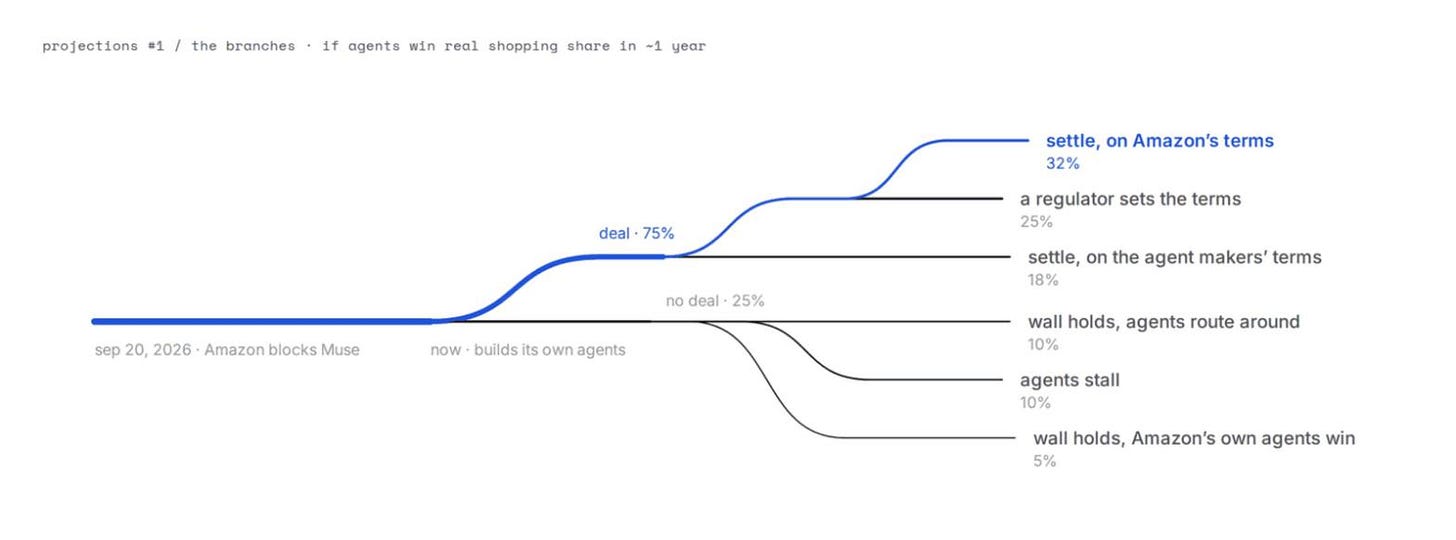
Walk the endings in the live tree. Each shows its precedent, what it does to the ad equation and the tell to watch for.
Deal, 75%.
Settle on Amazon’s terms, 32%: this is the airline path. Amazon holds long enough to name the price of being integrated, then allows agents inside its walls and probably gets visibility into consideration and attribution.
A regulator sets the terms, 25%: Australia in 2021, Canada in 2023; likelier in Brussels than in Washington D.C.
Settle on the agent makers’ terms, 18%: the hotel path. Agents win share faster than Amazon’s traffic erodes, and Amazon pays to be chosen the way hotels pay Booking and Expedia, which became the demand source, took 15-25% commission with rate parity, and shrugged off years of “book direct” campaigns. Airlines settled from strength because there were few of them; hotels settled from weakness because there were many.
No deal, 25%.
Agents are not good enough, 10%: the “thin client” idea of 1996 (Oracle’s Network Computer and Sun’s JavaStation ran everything off the network, a decade before the network could carry it; the idea came back as Gmail and Chromebooks) and voice shopping in 2018 (Alexa was going to be how people bought things, and settled into reorders). Both times the interface arrived before the infrastructure and people went back to the source. And agents are already pretty good, which is why this gets 10%.
The wall holds and agents route around it, 10%: Amazon keeps its page, and the demand that wants an agent moves to retailers who let one in.
The wall holds and Amazon’s own agents win, 5%: Rufus, Alexa and Buy for Me become the agent layer for Amazon shopping, and sponsored inputs move in-house.
Two questions pick the ending.
Do agents win real shopping share, and how fast? That will determine deal or no deal; the weights above assume they do, within about a year.
And is Amazon an airline or a hotel? That decides whose terms.
The evidence says Amazon is an airline, and not because of the catalog. Almost nothing on Amazon is exclusive as an item: Walmart’s assortment is a subset of Amazon’s, and the same sellers list on both at the same prices (Marketplace Pulse). What is exclusive is the bundle: catalog, logistics, Prime one- and two-day delivery at a price nobody is allowed to beat, along with Prime members and their wallets. Access to Amazon is access to that bundle.
The blue thread
The likely ending: a deal on Amazon’s terms, and how it might play out for ads.
Agent to Agent. The endgame that solves Amazon’s identification problem is Muse announcing itself and negotiating with Amazon’s agent. Amazon keeps control and still transacts. The rails for that conversation already exist: Google’s Universal Commerce Protocol, launched at NRF in January with Shopify, Etsy, Wayfair, Target and Walmart and endorsed by Visa, Mastercard, Stripe and Best Buy, runs over A2A and MCP and settles payment through AP2 with a cryptographic proof of the user’s consent. Amazon is not on that list. An airline does not join the open standard; it negotiates its own terms.
What could the settlement do to ads. Once the agent is the buyer, sponsored placement has nothing to nudge, and every term in the unit economics moves
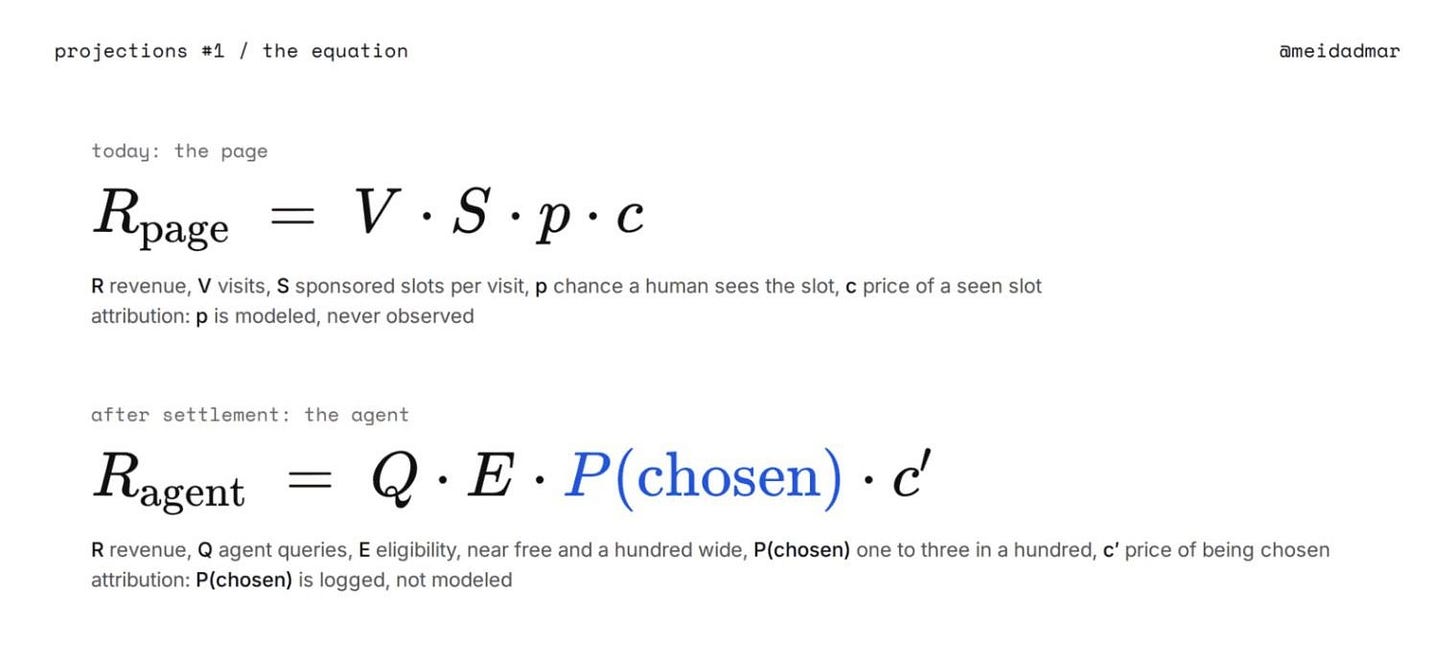
The impression dies. No human sees the page, so nobody pays for a view.
Slots collapse. A dozen sponsored positions become the one to three offers the agent shows.
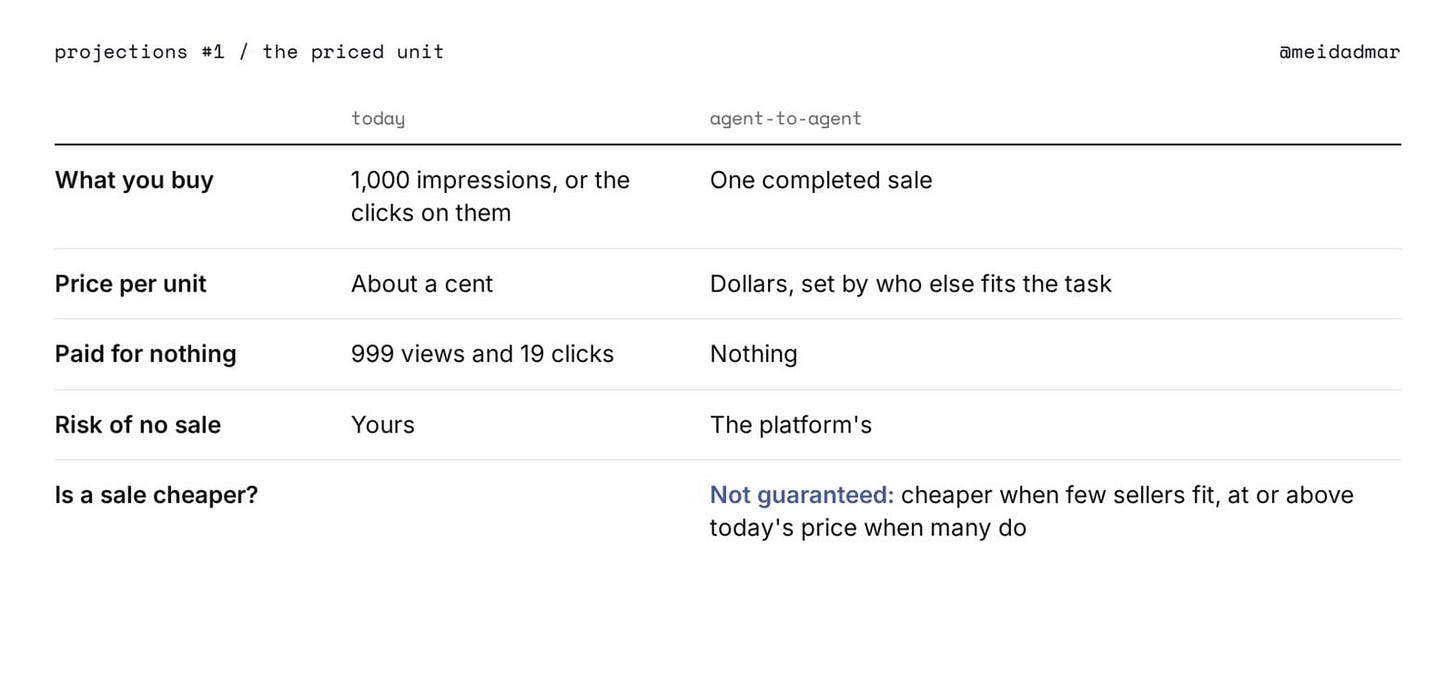
You pay for the sale, not the chance of one. Today you buy a thousand impressions or the clicks on them, one person buys, and the platform keeps the bill either way. In agent-to-agent the only unit left is the outcome. Terms aren’t public yet, but the likely model is that you pay when the agent picks you and the sale completes: pricier per unit, no more paying for the misses, and the risk of no sale moves from advertisers to the platform. Whether a sale ends up cheaper depends on how many sellers are competing to be the one picked.
Demand may grow while the page shrinks. The agent removes the app load, the tabs and the distractions that leak shoppers today. Amazon may earn less of a larger total.
Attribution becomes a log. The agent records why it chose you and why it didn’t. Whoever owns the agent owns the log, and that is monetizable power too.
Next up: a proper breakdown of ads in the agentic space, then local vs cloud LLMs.
Sources
Amazon blocks Meta’s Muse AI assistant, GeekWire, Sep 20 2026
Amazon Floods Search Results with Ads, Consumers’ Checkbook, Nov 2024
Amazon, Walmart, Temu, and Shein Overlap, Marketplace Pulse, Mar 2024
Universal Commerce Protocol announcement, Google, Jan 11 2026
Why Amazon blocked Meta’s AI agent (Amazon’s statement), Forbes, Sep 23 2026